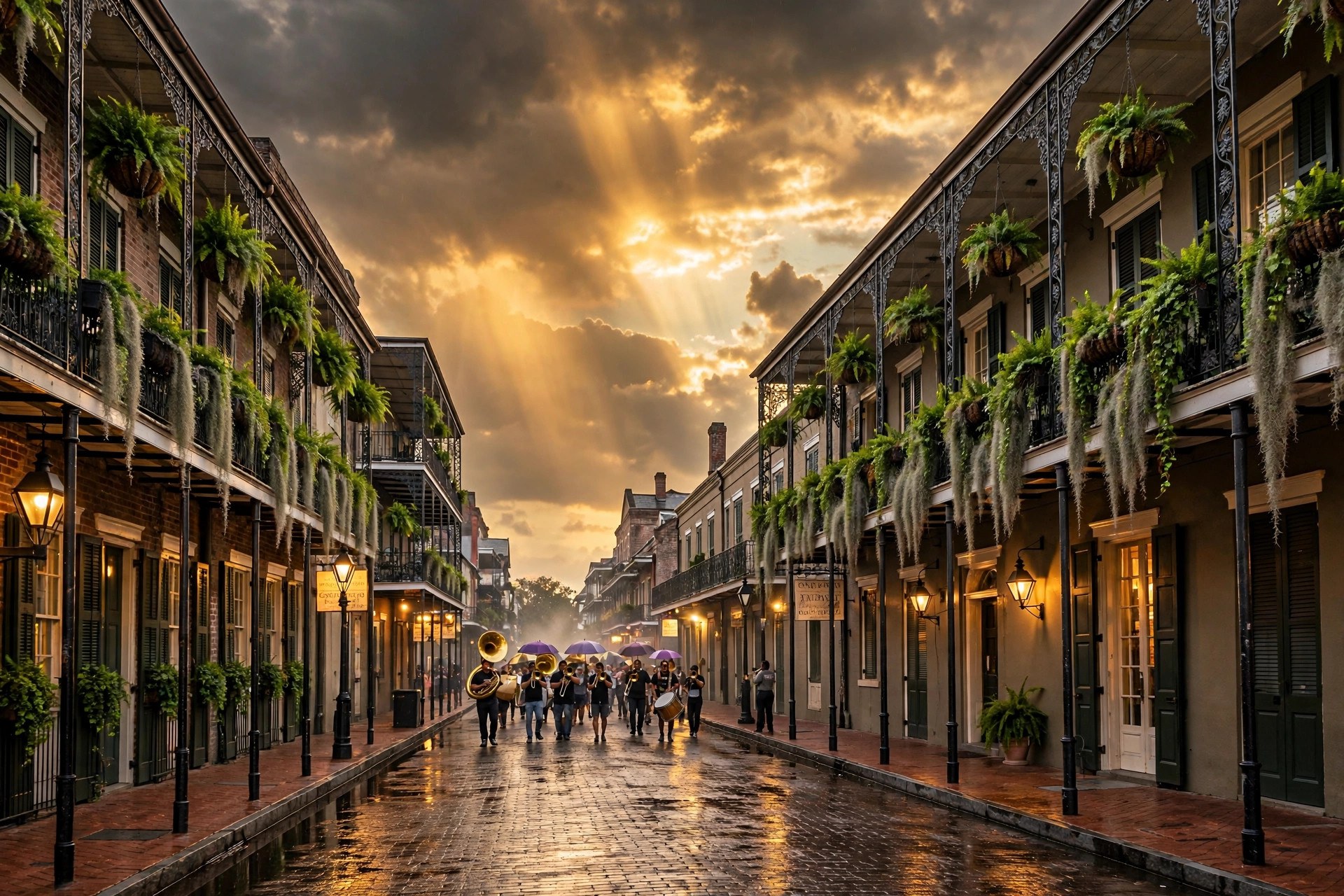
New Orleans is best approached not as Bourbon Street plus Mardi Gras, but as a city where the tourism product and everyday culture are unusually intertwined. Its competitive advantage is the concentration of living Black, Creole, French, Spanish, Caribbean, and broader Gulf South traditions, music, food, architecture, parading, religion, and neighborhood life, within a relatively compact urban area.
Nearly 20 million visitors a year come for that combination. The strongest trip mixes food, music, and nightlife with Tremé, Uptown, City Park, the riverfront, and neighborhood history, and treats those neighborhoods as living communities rather than entertainment sets.
Why people come
A music pilgrimage
Jazz was born here, in the interaction of African and Caribbean musical traditions at Congo Square, brass bands, and Black neighborhood parading. The lineage is still audible nightly: traditional jazz, brass bands, blues, bounce, and second lines are community institutions first and visitor experiences second.
A food pilgrimage
Eating is how the city's migration history becomes visible. Gumbo, red beans and rice, jambalaya, po-boys, muffulettas, oysters, pralines, and beignets sit alongside Creole fine dining, Vietnamese-Louisiana cooking, and Caribbean influences. The best cultural understanding comes from eating beyond the French Quarter.
The festival calendar
Mardi Gras is the famous one, but the non-Carnival calendar is arguably stronger: French Quarter Festival, Jazz & Heritage Festival, ESSENCE Festival of Culture, Satchmo SummerFest, Southern Decadence, and a full fall music season. Festival travelers should build the trip around the event, not bolt it onto a sightseeing day.
It is walkable and human-scaled
A relatively small city with a very large cultural footprint. Most first-time itineraries need no car: the Quarter, Marigny, CBD, and Garden District connect on foot and by streetcar, and the streetcars themselves are part of the experience.
Game weekends and the river
Saints home weekends fill the city on their own logic, and the Port of New Orleans is a working Caribbean cruise homeport, which makes the city both a destination and a departure point.
The culture, briefly
Congo Square to the second line
The National Park Service traces jazz's development to this city's unusually dense cultural interaction: African drumming and dancing at Congo Square, brass-band traditions, Black social-aid organizations, and neighborhood parading. Social-aid clubs historically provided community support as well as parading, and their parades created both employment and musical training for musicians. A public second line today is a community institution, not street entertainment; participation should be respectful, especially around club members, families, and memorial elements.
Creole is not Cajun
The most persistently oversimplified distinction in Louisiana tourism. Creole culture emerged from the interaction of French, Spanish, African, and Native American peoples in colonial Louisiana; the term has carried many meanings and cannot be reduced to a single race. Cajun derives most directly from Acadian settlers, and its historical heartland is Acadiana and rural southwestern Louisiana more than urban New Orleans. The city is fundamentally a Creole and Black Atlantic city with substantial Cajun influence, not simply Cajun country.
Living traditions
Black Masking Indian processions, with their hand-sewn suits, parade on Super Sunday and St. Joseph's Day as well as Carnival. The city's spiritual landscape carries a strong Catholic and Creole calendar alongside living African diasporic traditions, Voodoo, Hoodoo, Vodou, Ifá, and Òrìṣà. Treat these as continuing practices, not supernatural décor and not photo opportunities.
Katrina's mark
In August 2005, levee failures after Hurricane Katrina flooded most of the city and scattered its people, including its musicians, across the country. The return, rebuilding, and remembrance since then are part of the city's living culture, not a closed chapter: Tremé, the Lower Ninth Ward, and the musician community carry it most visibly. Visit with that history in mind, and be wary of any tour that treats it as spectacle.
Where the music lives
Bourbon Street and Frenchmen Street serve different markets. Bourbon is the highest-intensity visitor nightlife corridor. Frenchmen, in the Marigny, is oriented toward live jazz, brass, blues, and related clubs, though it too is now heavily visited. Uptown, Magazine and Freret Streets, and parts of the Warehouse District offer a third model: neighborhood rooms without Bourbon's density.
- Preservation Hall, French Quarter, traditional jazz in its original room
- Tipitina's, Uptown, the city's rock and funk institution
- Maple Leaf Bar, Uptown, long-running live music room
- Snug Harbor, Marigny, modern jazz club on Frenchmen Street
- The Spotted Cat, Marigny, Frenchmen Street staple
Listed as institutions, not rankings. For a musically serious evening, combine one booked performance with spontaneous listening rather than treating the night as bar-hopping.
Eat like the city eats
Do not spend every meal in the French Quarter. Uptown, Mid-City, Tremé, and Marigny/Bywater broaden the picture from iconic visitor dishes to the foods New Orleanians build weekly routines around.
Gumbo, red beans and rice, jambalaya, po-boys, muffulettas, oysters, pralines, beignets.
- Café du Monde, French Quarter, the landmark beignet café
- Commander's Palace, Garden District, Creole fine dining
- Dooky Chase, Tremé, Creole fine dining with deep civil-rights history
Food is often served more leisurely than an efficiency-focused traveler expects. In this city that is usually a feature, not a failure. Leave time between dinner and a ticketed set.
Neighborhoods
Tourism happens in residential neighborhoods, not a sealed resort district. Where you stay changes the character of the trip nearly as much as what you do.
French Quarter
First visits, history, maximum walkability. Most tourist-heavy; nightlife noise is real.
CBD / Warehouse District
First-timers who want convenience: museums, the Superdome, large hotel inventory, walkable to the Quarter.
Marigny
Live music, couples, repeat visitors. Frenchmen Street at the door; smaller lodging inventory.
Bywater
Repeat visitors, art and café scene. Residential and quiet; respect it.
Garden District / Uptown
Quieter stay, architecture, families. The St. Charles streetcar runs the oak-lined axis downtown.
Tremé
Black history and cultural depth: Congo Square, Louis Armstrong Park. Best approached as a living historic neighborhood.
Mid-City / Bayou St. John
City Park, the sculpture garden, bayou recreation, local feel.
Beyond Mardi Gras
- French Quarter Festival, spring
- New Orleans Jazz & Heritage Festival, late April into May
- ESSENCE Festival of Culture, summer
- Satchmo SummerFest, summer
- Southern Decadence, Labor Day weekend
- Fall music and food festivals into November
Festivals consume most of a day and move hotel rates sharply. Price exact lodging dates before anything else.
When to go
March through April
The best all-around window: comfortable temperatures and the strongest spring festival calendar.
Late October through November
The best alternative: comfortable weather, a less frenetic pace. Hurricane season officially runs through November 30.
June through September
Lower demand and better lodging availability, with real trade-offs: highs near 91°F, heavy humidity and rainfall, and tropical-cyclone risk. Midday pacing, hydration, and indoor breaks become necessities.
December through February
Mild but not warm: normal January lows near 46°F, and damp wind can feel cooler. Bring layers.
Getting around and staying
Skip the car
For most first-time itineraries, not renting a car is the better default. Downtown parking is an added expense, and the core is walkable or transit-served. Streetcars are functional transportation and an attraction at once; the St. Charles line runs 24 hours.
Transit fares
RTA streetcar and bus rides run $1.25, with Jazzy Passes at $3 for a day, $8 for three days, and $15 for seven days; the Algiers ferry is $2. Last checked October 2026; confirm in the Le Pass app before budgeting tightly.
Where to stay
One to three nights, first visit: French Quarter or CBD/Warehouse for logistics. Music-first: lower Quarter or Marigny near Frenchmen. Couples and quiet: Garden District or Uptown. A week or a repeat: Mid-City, Uptown, or Marigny, where the trip has time for neighborhood rhythms.
Access and safety
Old tree roots and aging infrastructure make for uneven sidewalks; all red streetcars are ADA-accessible, while the historic green St. Charles fleet is only partly so, so plan boarding stops in advance. Treat the city as an active American city with large nightlife crowds: stay on active streets at night, secure valuables in dense crowds, and ride rather than walk late across neighborhoods.
Three ways in
One day, first visit
Morning: French Quarter on foot, Jackson Square, Royal and Chartres, the riverfront. Afternoon: a Creole lunch, then Tremé and Congo Square. Evening: dinner, then traditional jazz or Frenchmen Street. Resist adding the Garden District, City Park, and a swamp tour; the city's value is partly in lingering.
Three days, classic
Day one: Quarter, riverfront, Tremé. Day two: the St. Charles, Garden District, and Uptown axis with Magazine Street. Day three: City Park and the sculpture garden, or the Warehouse District museums. Evenings: one Frenchmen night, one dinner-and-music night, one flexible neighborhood night.
Seven days, deep
Slow down deliberately. Add a wetlands excursion, museum days, a daytime neighborhood with no headline attraction, and at least one evening where the venue, not the district, is the destination. A seven-day transit pass makes this style of trip remarkably economical.
Travel gently
- Neighborhoods are homes first. Keep volume down on residential blocks, ask before photographing people, and remember second lines and Masking Indian processions are community practice, not content.
- Tip as part of the cost of dining: 15 to 20 percent for sit-down service, and check whether gratuity is already included for larger parties.
- Short-term rentals are tightly regulated and platforms must verify permits; a licensed hotel, B&B, or guesthouse removes the risk of a disrupted booking.
- Bring excellent walking shoes in every season. Historic paving rewards them more than fashion footwear does.
Questions, answered honestly
When is the best time to visit New Orleans?
For comfortable outdoor sightseeing, October–November and March–April are supported shoulder-season choices; October averages about 79°F/60°F (26°C/16°C), while November averages about 70°F/51°F (21°C/11°C) in one 2026 guide (TravelTourister). Typically: Mar, Apr, Oct, Nov.
How much does a trip to New Orleans cost per day?
Budget: ~US$115 per person per day Mid-range: ~US$225 per person per day Luxury: ~US$475 per person per day As of October 2026, use planning ranges of **$95–$135 budget**, **$175–$275 mid-range**, and **$350–$600+ luxury per person per day**, excluding flights; the figures include accommodation, food, transport, and activities in the 2026 These are planning ranges from published cost guides, not live prices.
How do I get to New Orleans and get around?
Louis Armstrong New Orleans International Airport (MSY) is the primary airport. The RTA 202 Airport Express connects it with downtown; the city tourism transportation page lists a $1.25 fare and roughly 25–40 minutes, but does not date the fare (Getting Around New Orleans Without a Car).
Is New Orleans safe for tourists? Any local rules to know?
Summer heat and humidity can be intense, and hurricane-season disruption is possible; consider flexible plans and check forecasts and travel-insurance terms, particularly for storm cancellation coverage (TravelTourister).
What should I not miss in New Orleans?
Don't miss: Explore the French Quarter on foot, including Jackson Square, St. Louis Cathedral, Royal Street, and Café du Monde (Visit New Orleans; Finding the Universe).; Hear traditional New Orleans jazz at Preservation Hall; the 2026 guide lists standing and seated ticket options (Finding the Universe).; Spend an evening listening to live music on Frenchmen Street, where venues include the Spotted Cat and d.b.a. (Finding the Universe).; Ride the St. Charles Avenue streetcar past Garden District homes; the route is identified as line #12 (New Orleans & Company)..
Who is New Orleans best for?
Food lovers, Culture buffs, Nightlife, Music fans, History buffs, Festival travelers, Families, LGBTQ+ travelers
What is New Orleans known for?
A distinctive mix of live jazz, Creole and Cajun food, historic neighborhoods, festivals, and Mississippi River experiences. First-time highlights include the French Quarter, Jackson Square, Café du Monde, the St. Charles streetcar, City Park, and Frenchmen Street (Visit New Orleans; Road Genius).