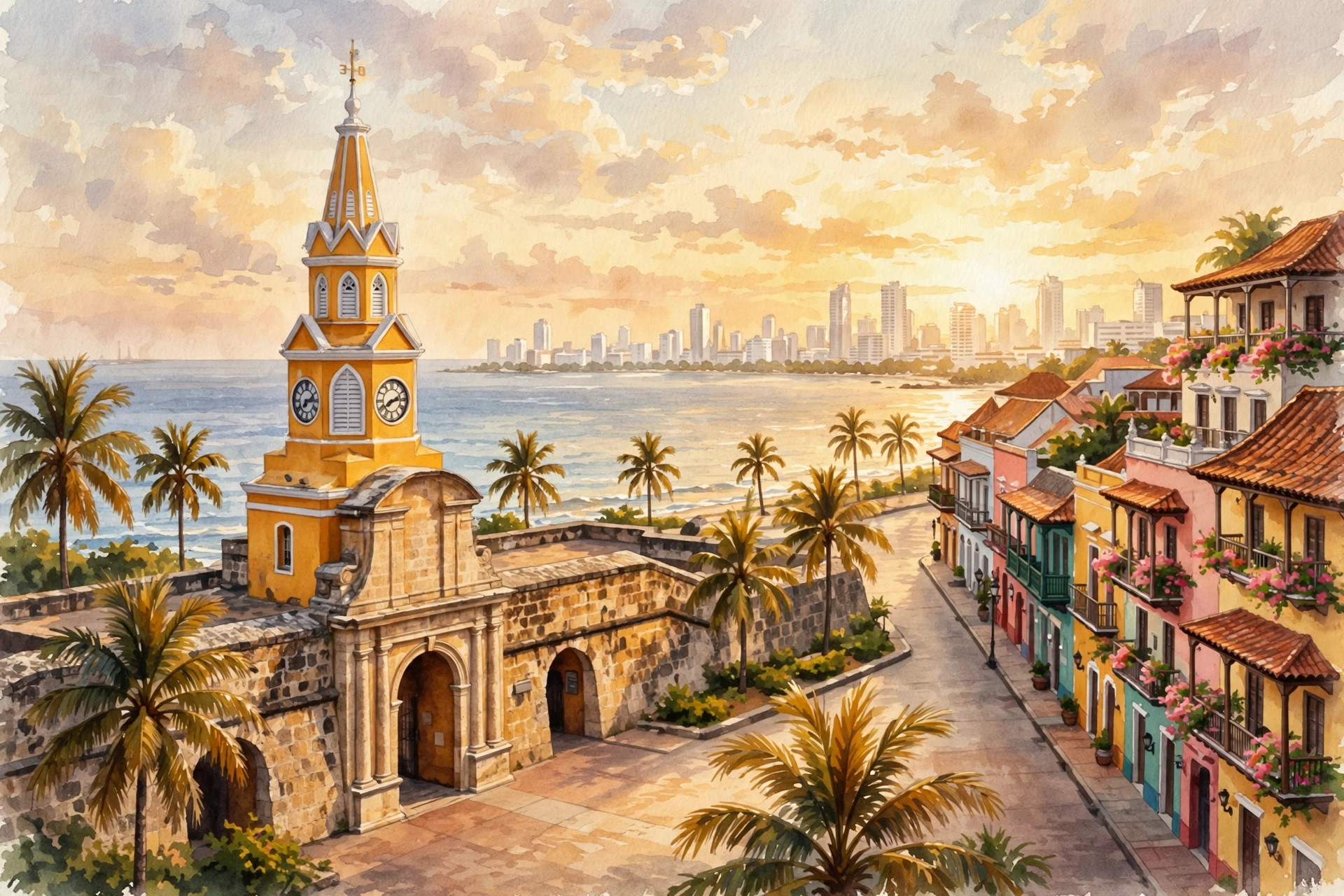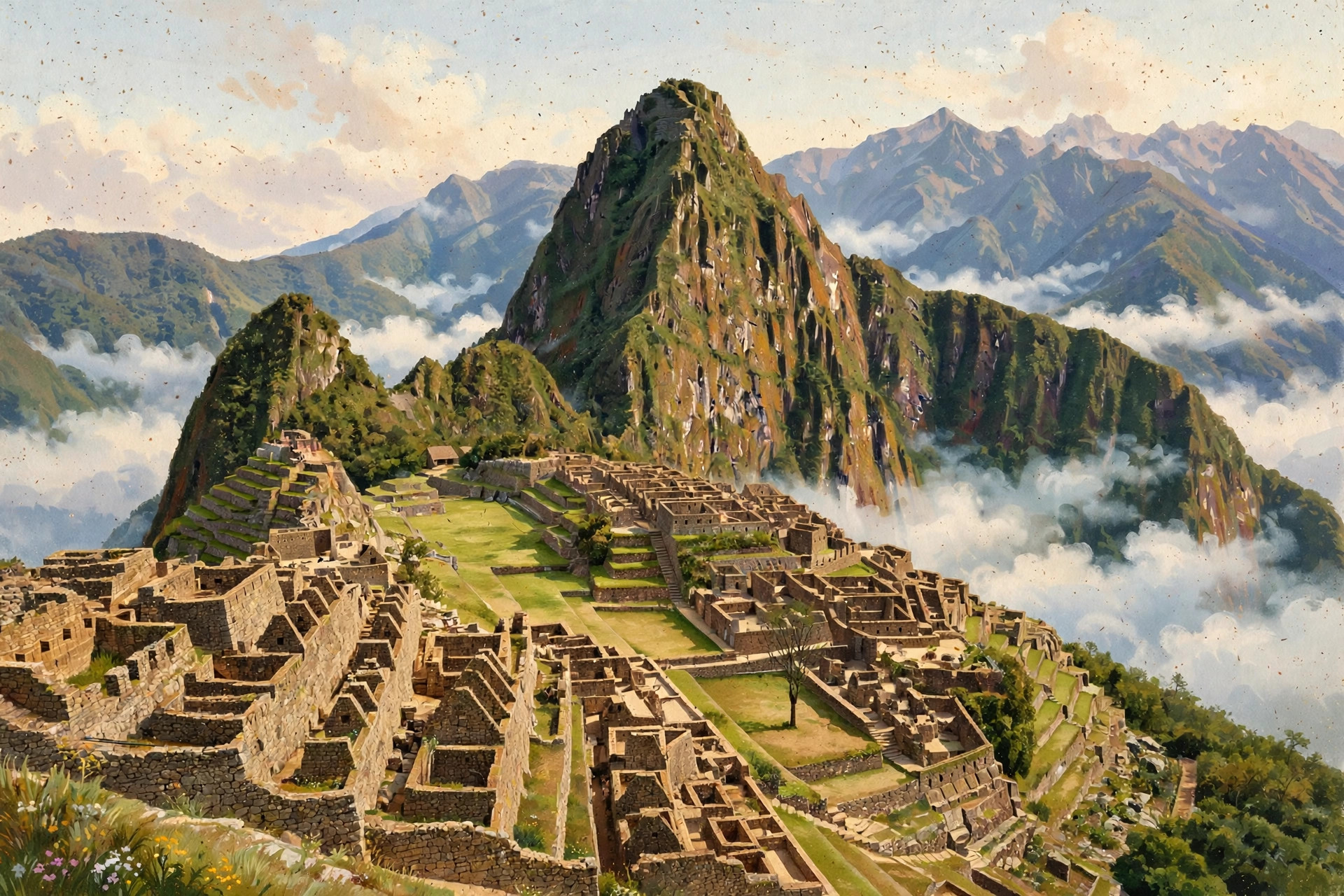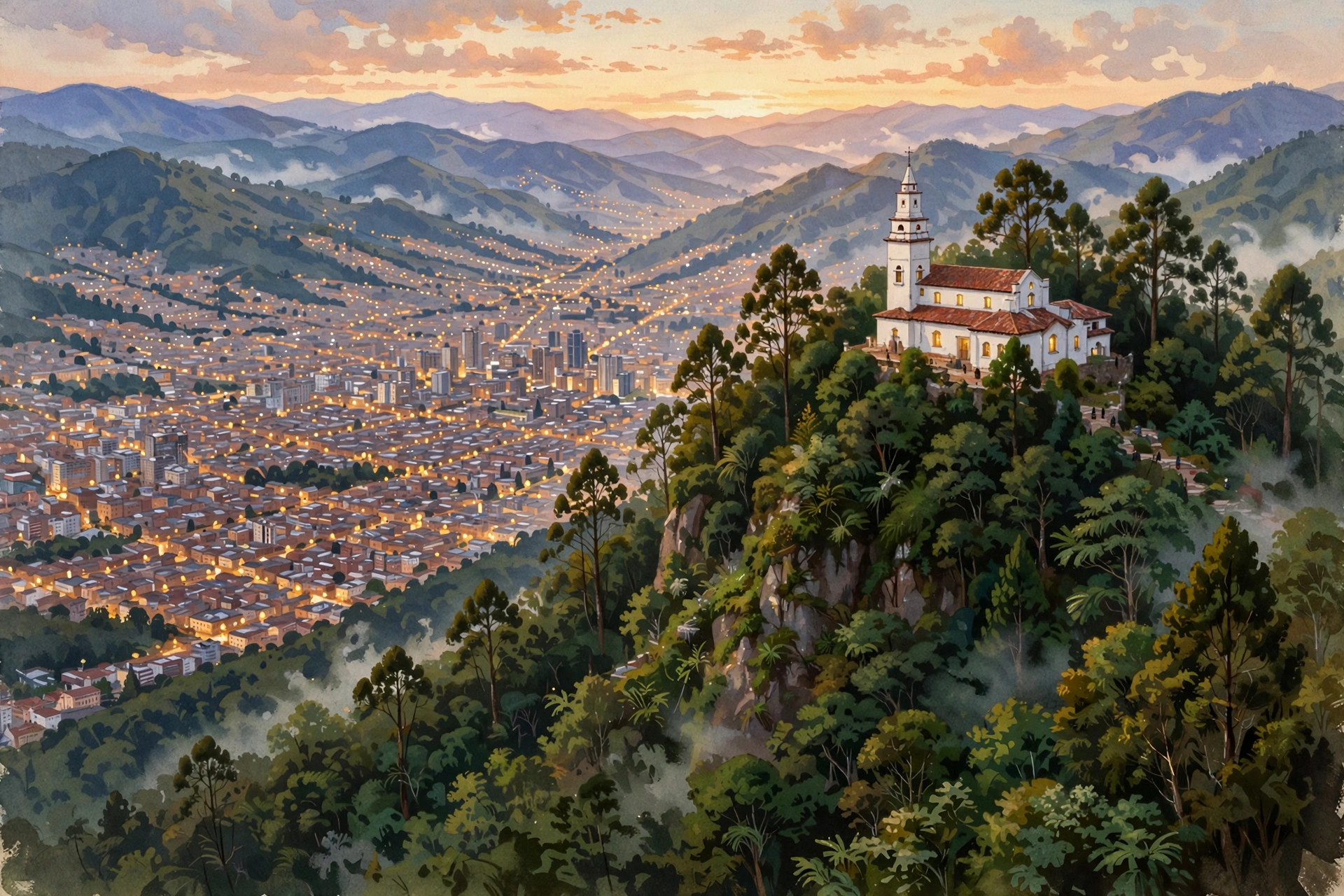
Fourteen days is enough for three countries when the route does the work. This circuit enters in the north and exits in the south, never backtracking: every leg is a short flight along a capital-to-capital air corridor, and the order of the stops is part of the design. Sea-level Lima is placed on purpose between the altitude blocks, and the highest city, Cusco, comes last, after the body has climbed in steps and slept low in the Sacred Valley.
Days 1–3 — Bogotá, the northern door (2,640 m)
Bogotá is the northern door, at 2,640 m. Start with the Monserrate sanctuary above the city, the Gold Museum, and La Candelaria's colonial streets, and take the day-trip out to Zipaquirá's salt cathedral.
Stated plainly: the Coffee Region is deliberately omitted on 14 days. It deserves 2–3 days of its own (see the Coffee Region guide); forcing it in would cost Machu Picchu its margin.
Days 4–6 — Quito, the middle (2,850 m)
Fly Bogotá to Quito (BOG→UIO, ~2 hrs, several flights daily) and climb one small step, to 2,850 m. The days go to the UNESCO historic centre and Mitad del Mundo, with an Otavalo market day-trip.
Ecuador's capital is the only gateway on this route that also opens the Galápagos. That pairing has its own itinerary, linked below; on Circuit A, Quito is the middle of the staircase.
Days 7–8 — Lima, the breather (sea level)
Fly Quito to Lima (UIO→LIM, ~2.3 hrs non-stop) and come all the way back down to sea level. This stop is placed deliberately: two nights at sea level between the highland blocks, resetting the body before the final climb.
The breather is not a pause in the trip. Barranco and Miraflores, Museo Larco, and one booked tasting-menu night fill it: Lima's restaurants lead the world, so book that table as early as the flights.
Days 9–11 — Down to the Valley, up to the citadel
Fly Lima to Cusco (LIM→CUZ, ~1h20) and transfer straight down to the Sacred Valley to sleep low: Urubamba, at about 2,871 m, or Ollantaytambo, at about 2,792 m. The valley days cover Pisac, the Maras salt pans, and Moray.
Then the Machu Picchu day. Entry is circuit-based and timed, capped at 4,500 visitors a day, and tickets are sold only via Tu Boleto: named, passport-tied, with Circuit 2 selling out first. Book 60+ days ahead, and check before you go, because circuits and caps change.
One honest note: the 4-day Inca Trail (500 permits a day, closed all February) does not fit a 14-day three-country trip. If the trail is the point, drop a country.
Days 12–14 — Cusco, the payoff (3,400 m)
Three nights in Cusco, at 3,400 m: Qorikancha and the Inca stonework, the Plaza de Armas, and San Blas. Because the route climbed in steps and slept low first, Cusco is enjoyed, not endured.
Day 14: fly Cusco → Lima → home.
The altitude staircase, climbed in the right order
Bogotá 2,640 m → Quito 2,850 m → Lima 0 m → Sacred Valley ~2,800 m (sleep low) → Cusco 3,400 m.
The routing order is a health feature. Land in Cusco cold, straight from sea level, and altitude sickness decides your trip. This sequence acclimatizes in steps instead, with a sea-level reset in the middle: two highland blocks that rise gently, a breather at the coast, a low-sleeping valley, and only then the highest nights.
The same staircase is why the trip runs north-to-south and never reverses. Run it backwards and the staircase becomes a cliff.
The route
Schematic — not for navigationOne corridor, north to south, with no backtracking:
- Bogotá → fly ~2 hrs → Quito
- Quito → fly ~2.3 hrs → Lima
- Lima → fly ~1h20 → Sacred Valley
- Sacred Valley → train → Machu Picchu
- Machu Picchu → Cusco
- Cusco → fly out via Lima
All three capitals are visa-free for US/UK/EU tourists in practice (~90 days each): administratively one trip, three countries. Entry rules change, so check before you go. Illustrative schematic. Not for navigation.
When to run this circuit
May–September is prime, and this circuit is built for it. All three highlands are in dry season at once, the Amazon is drier from June, and Machu Picchu sits in its peak window — which is also when its tickets book out furthest ahead, so the 60+ day rule below bites hardest in these months.
December–March is the corridor's other season. Colombia is in its dry months, the Galápagos is in its warm season, and coastal Peru has its sun — but the Andean highlands of Peru and Ecuador are wet, and Circuit A is a highlands circuit. Run it then only with rain layers and flexible plans; in that season the coasts and the islands are the product, not the citadel.
October–November is the honest shoulder: no stop on this route in prime condition, in exchange for thinner crowds and softer prices.
The capacity truth, before you book
Machu Picchu admits 4,500 visitors a day in regular season, and 5,600 on designated high-season dates. Tickets are sold only via Tu Boleto, are personal and passport-tied, and should be booked 60+ days ahead; for June–August, Circuit 2, and Huayna Picchu, allow 2–3 months. The booking order on this circuit is fixed: tickets first, then trains, then hotels.
Safety, framed as published: Colombia carries a US Level 3 advisory, with Level 4 zones that sit off this circuit (see Colombia essentials). Ecuador's highlands sit under the national Level 2, while coastal provinces carry heavier advisories; this circuit stays in the highlands (see Ecuador essentials). Advisories change, so check before you go.
What this route costs — the pattern, October 2026
| Leg | The pattern | The basis |
|---|---|---|
| The two international hops (BOG→UIO, UIO→LIM) | ~$170–$285 per hop booked ahead, ~$350–$550 total | Aggregator snapshots from XSCOPE research, October 2026 |
| Domestic hops (LIM→CUZ return) | Priced like a domestic shuttle | A high-frequency route: ~266 flights/week sampled in research |
| Guided operator versions of the Ecuador–Peru spine | ~$6,300–$6,500 per person | Intrepid 17–25-day trips listed via TourHub |
Those operator prices are market context from published listings, not an XSCOPE price. XSCOPE sells guides, not tours; nothing on this page is bookable, and no operator named here is a partner.
Where you'd sleep
- Bogotá: La Candelaria for history, or the northern districts for polish.
- Quito: historic-centre courtyards.
- Lima: Miraflores or Barranco.
- Sacred Valley: valley towns chosen for altitude.
- Cusco: San Blas lanes, or near the Plaza.
We don't sell rooms, and no property is a partner. These are the neighbourhoods and styles we would book ourselves.
More days? Spend them here
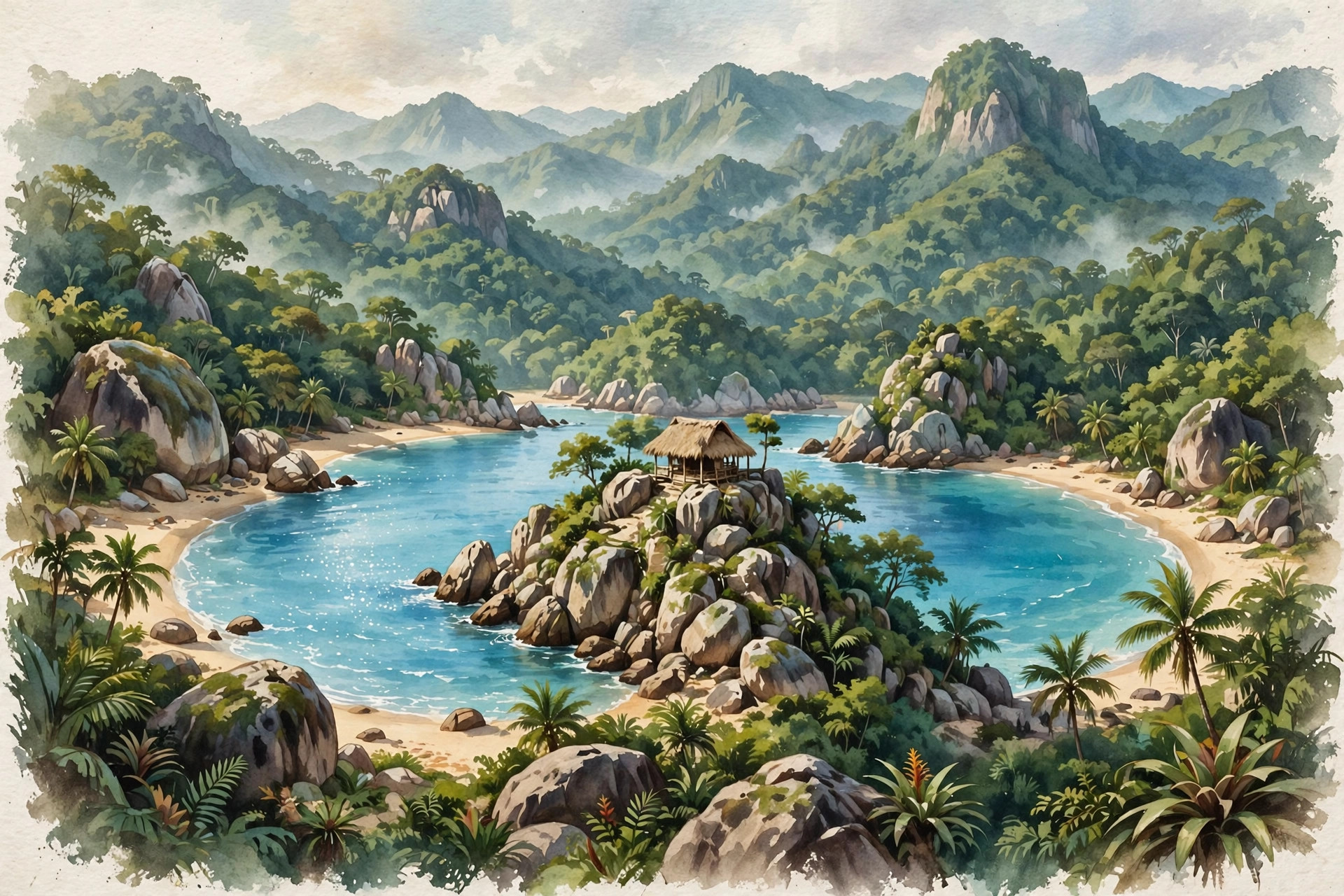
Add 3–4 days at the start. Tayrona closes for Respira Tayrona on 1–15 Feb, 1–15 Jun, and 19 Oct–2 Nov, the park's 2025 rule requires a yellow-fever certificate, and it is best in the Dec–Mar dry season. Check before you go.

Galápagos cannot fit 14 days honestly. It needs +4–5 days of its own. The Machu Picchu + Galápagos itinerary is the way to add it.
Plan it yourself with the guides
Our $4.99 guides are at Make This Trip Real, with a free sample first. The country editions behind this circuit: Colombia guides, Ecuador guides, and Peru guides.
No paid placements yet — when affiliate links go live here, they will be disclosed.