Why visit
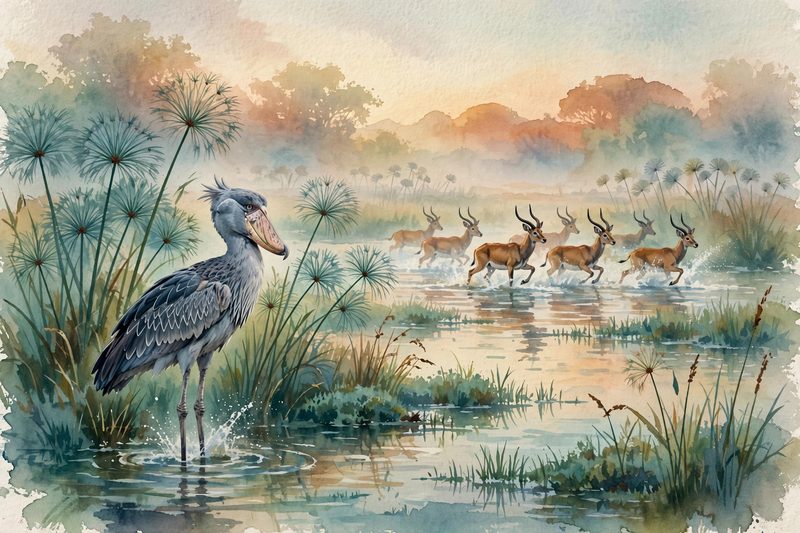
The shoebill stork, reliably and ethically: guided tracking with strict nest-visit rules, in one of the bird's last strongholds. Black lechwe herds of over 50,000, one of Africa's great ungulate spectacles, found almost nowhere else on earth. Around 400 recorded bird species: wattled cranes, saddle-billed storks, swamp specialists, plus sitatunga antelope. Mokoro and canoe excursions through the channels, plus guided walks when the flood recedes. A working model of community-led conservation: six chiefdoms, fishermen as nest guards, revenue that stays local. And true remoteness: few vehicles, few visitors, and wetlands that feel close to pristine.
Signature experiences
- Shoebill tracking: dawn walks with local trackers to find the birds feeding in the papyrus; the strike, when it comes, is devastatingly fast.
- Shoebill nest visits: strictly managed. Operator listings state visits are limited to about five minutes and are not open to children under 12, run through the nest-protection program; confirm both rules with your operator when booking and respect them absolutely.
- Black lechwe herds: over 50,000 animals moving across the receding floodplain, the sound of hooves in shallow water.
- Birding: wattled cranes, saddle-billed storks, and 400-odd bird species, among the richest wetland birding in Africa.
- Mokoro and canoe excursions: silent water-level travel through the channels; water-level dependent.
- Night in camp: hyenas calling, the wetland chorus, and some of the darkest skies in Zambia.
- The David Livingstone memorial: near the wetlands at Chitambo's village, where Livingstone died in 1873 and where his heart was buried; a worthwhile cultural stop on overland routes, but 2026 access and condition are unverified. Contact African Parks' Bangweulu staff before travelling.
Seasonality
Shoebill tracking: the two sources genuinely disagree, so here is the honest position. Safari operators cite May to July as the peak window, coinciding with nesting and the best tracking conditions, when water levels allow access and birds are findable. Lonely Planet's Zambia coverage instead calls March to April the best shoebill months and says September to November is poor. Shoebill visibility shifts with water levels and nesting each year, and no month guarantees a sighting. There is no established current consensus: confirm with your operator whether current advice favors March to April or May to July before booking. Book early either way; capacity is limited.
Black lechwe herds, June to July: as the floodwaters begin receding, the herds concentrate on fresh green plains. This overlaps well with the operator shoebill window, making June to July the best combined window.
General birding, September to November: excellent for overall bird diversity, though shoebills are harder then.
Wet season, November to April: heavy rains (1,200 to 1,400 mm annually), highest water. Access is difficult; most camps operate May to November.
Getting there and getting around
Getting there: fly. The standard route is a charter flight from Lusaka or Mfuwe (South Luangwa) to the Chikuni or Chimbwe airstrips inside the wetlands, arranged through your camp or a Lusaka operator. Seat-rate availability, routes, and minimum passenger numbers for 2026 are unverified; confirm current arrangements directly with your operator. Overland, the drive from Lusaka via Mpika and Kasanka is a long, rough expedition suited to self-drivers with time and a properly equipped vehicle. Some itineraries combine Bangweulu with Kasanka National Park, about 50 km to the south. There are no scheduled commercial flights into the wetlands.
Getting around: you move with guides, full stop. Shoebill tracking is on foot with experienced local trackers, often combined with mokoro or canoe legs through the channels, depending on water levels. Game drives use park vehicles with community guides. From roughly August to October, when boat trips stop as waters drop, guided walks and vehicle-based viewing take over. Distances are large and the terrain is trackless wetland; self-driving inside the core area is not a visitor option.
Where to stay and budgets
Areas: the western side near Shoebill Island for the classic shoebill camps; Nsobe in the south for the community camp; all stays are inside or on the edge of the wetland system.
Iconic properties: Shoebill Island Camp (Remote Africa Safaris), four tents on a small island on the western side, positioned for the shoebill experience with walking, photographic canoeing and mokoro. Nsobe Community Camp, a rustic community-run campsite that generally operates in the drier season, often around May to November, but opening depends on water levels and the camp being dry. Confirm dates and facilities directly with African Parks before travelling; current facilities are unverified for 2026. Luxury safari camps run roughly $600 to $1,000+ per person per night all-inclusive; community and rustic camps a fraction of that; camping self-drive is the cheapest option. Confirm current rates with operators, as capacity is tiny and prices move.
Rough daily planning figures for October 2026, per person excluding international flights: about US$400 as a lower benchmark, about US$600 mid-range, and about US$1,088 as a luxury-package proxy (from an eight-night shoebill safari at $8,704 per person, divided by eight). These are package or general estimates, not itemized Bangweulu budgets, and park-entry fees, conservation fees, camp rates, and activity charges are not stated in the sources. Community canoe trips were quoted around ZMW200 per person and motorboats around ZMW400, but those figures are unconfirmed for 2026. Get current written quotes and confirm before you go.
Risks and local rules
- Visa: standard Zambia entry rules apply. The KAZA Univisa (US$50, up to 30 days) permits multiple visits between Zambia and Zimbabwe; it is irrelevant here unless combining with Zimbabwe. All visa details: verify 2026.
- Health: remote wetland means high malaria risk. Prophylaxis is essential, plus repellent, long sleeves, and nets. The nearest serious medical care is hours away in Lusaka or Ndola; comprehensive travel insurance with medical evacuation is non-negotiable. Carry a full personal medical kit.
- Safety: the risks are environmental, not criminal: deep water, hippos, crocodiles, and getting lost in trackless wetland. Never leave camp or walk without a guide. Bilharzia may be present in still shallow water; avoid wading except where guides approve.
- Money: cash only, and there are no ATMs within reach. Bring enough kwacha (ZMW) for park fees, community activities, tips, and contingencies. Camps are usually prepaid in USD.
- Language: English is official; Bemba is the language of the surrounding communities. Your guides will bridge both.
- Connectivity: effectively none. Some luxury camps carry satellite WiFi; otherwise expect a full digital detox. Download offline maps and confirm your operator's emergency comms before you go.
Travel gently
Bangweulu is the case study for doing this right, so hold it to its own standard. The Shoebill nest-guard program, running since 2012, employs local fishermen to monitor nests through the September to December breeding season; disturbed birds abandon eggs to predators, so nest visits are capped at about five minutes with no under-12s. Confirm the current rules with your operator, respect those limits absolutely, and never approach a nest independently. Tourism revenue is shared with the six chiefdoms through the African Parks partnership; choosing community camps and community guides keeps more of your spend local. The fisheries that feed tens of thousands of people are managed for sustainability; do not buy fish from unlicensed sellers and do not pressure guides for closer wildlife encounters.
Next in the Zambia guide
Questions, answered honestly
Will I definitely see a shoebill?
No ethical operator guarantees it, but Bangweulu has the most consistent sightings in Africa thanks to resident birds, experienced trackers, and the nest-protection program. Operator guidance favors May to July; Lonely Planet favors March to April. Confirm with your operator for the current season; even then, it is a wild bird in a vast wetland.
How do I actually get there?
Fly. Charter flights from Lusaka or Mfuwe to the Chikuni or Chimbwe airstrips, arranged through your camp or a Lusaka operator. Seat-rate availability and current routes are unverified for 2026; confirm arrangements directly. Overland is a serious expedition, not a day trip.
How many days do I need?
Three to four nights minimum: one travel day each way by air, and at least two full days for shoebill tracking plus the lechwe herds. Birders often stay longer.
What does it cost, roughly?
Luxury camps run high (several hundred dollars per person per night all-inclusive); the community camp is a fraction of that; flights are the other major cost. Get itemized quotes and confirm what is included before booking.
Can children come?
Older children who can walk quietly for hours will love it, but operator listings state that shoebill nest visits are not open to children under 12; confirm the rule with your operator when booking. The remoteness suits self-sufficient families.
Bangweulu or Kasanka for shoebills?
Bangweulu, by distance. Kasanka occasionally produces shoebills, but Bangweulu is the stronghold with the tracking infrastructure and the guard program. Combine both in October to December and you can add Kasanka's bat migration.