Why visit
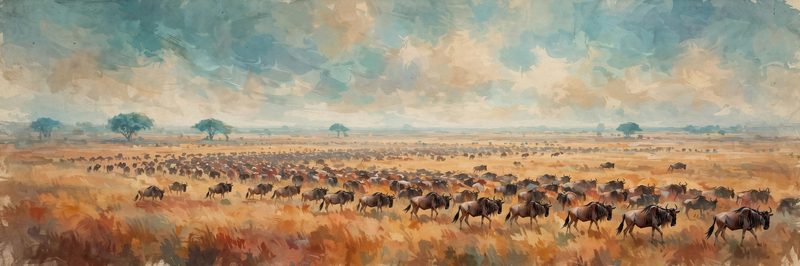
The wildebeest migration in November and December, tens of thousands strong, with almost no other tourists present. Spotted hyena in very high densities, filling the predator role lions play elsewhere. A recovering cheetah population and wild dogs on open ground made for watching hunts. Wet-season birding: wattled cranes, grey crowned cranes, and vast flocks of black-winged pratincoles. The Kuomboka ceremony of the Lozi people during the flooded season, broadly January to April, water-level dependent. And true remoteness: one permanent lodge, a few campsites, and horizons with nothing man-made in them.
Signature experiences
- The migration: an estimated 45,000 wildebeest calving on the southern plains as the rains begin, peaking around November into December.
- Spotted hyena clans, present in the hundreds and dominant on these plains.
- Cheetah and wild dog on open ground. Liuwa's lion population was rebuilt through reintroductions beginning in 2008, following the survival of the lone lioness Lady Liuwa; the park describes the resulting population as a small, growing pride, but a current 2026 headcount is not verified. Come for the hyenas as much as the lions.
- Cranes and pratincoles: wattled and grey crowned cranes, and clouds of black-winged pratincoles in their thousands.
- The Kuomboka: the Litunga's royal barge journey during the flooded season, broadly January to April, with timing depending on water levels; a centuries-old Lozi ceremony. Visitors may be able to attend; check current arrangements and follow local guidance.
- The earned sighting: no radio network, almost no other vehicles, and game viewing that takes patience and tracking skill.
Seasonality
Late October to December: the migration builds with the first rains and peaks around November into December. This is the prime window. It is also hot, and mosquitoes are at their worst.
January to March: do not attempt a drive-in visit. The park floods and tracks become impassable.
April and May: shoulder season. Wildflowers, green landscapes, good for photographers, fewer animals concentrated.
June to September: dry season. Easier driving, resident game around shrinking water, cool evenings. Lower wildebeest numbers but reliable general game viewing.
Getting there and getting around
Getting there: Liuwa is genuinely hard to reach, and that is the point. By road, enter via Kalabo town in Western Province, usually with an overnight stop in Mongu. Park guidance gives about ten hours from Lusaka to Liuwa's entry and reception via Kalabo; allow extra time for your route and conditions. At Kalabo harbour you cross the river by punt (a rope-and-pulley ferry), then check in with African Parks at the harbour reception before entering. A 4x4 with high clearance is mandatory; the sandy approach from Kalabo is the hardest section and drivers are advised to reduce tyre pressure. By air, charter flights from Lusaka or the Lower Zambezi take around 1.5 to 2 hours to the park airstrip. Scheduled Proflight flights from Lusaka to Kalabo are unconfirmed for 2026; confirm availability directly with Proflight before planning around them.
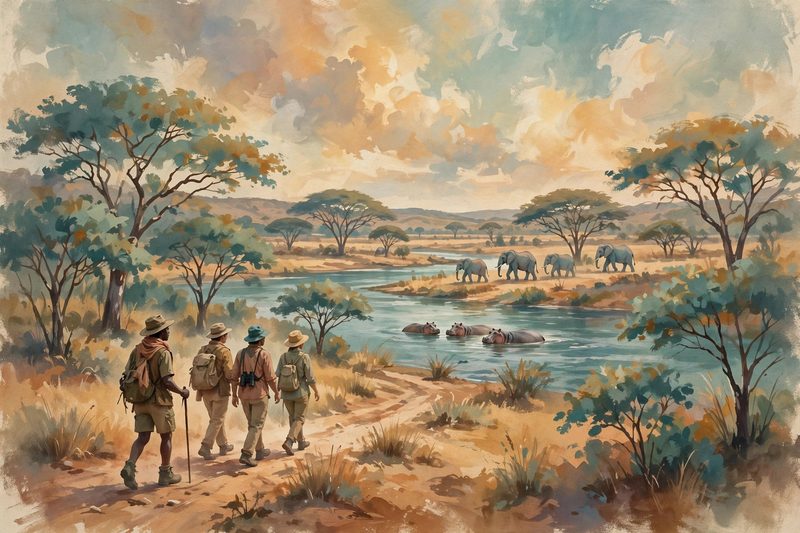
Getting around: guided game drives with the lodges are the standard way to see the park. Self-driving is possible with the right vehicle and preparation; community scouts can be hired at the Kalabo reception to ride along and guide (about $35 per day for international visitors in 2024 rates; confirm for 2026). There is no radio communication between guides, so game viewing takes patience and tracking skill. Walking safaris are offered by some operators.
Where to stay and budgets
Liuwa Camp: the park's permanent lodge. Note that an African Parks source refers to a camp as Matiamanene Camp; whether this is the same camp is unclear, so confirm with the park when booking. 2024 rates were about $540 per person per night for international guests, full board with two activities daily; confirm 2026 rates before booking.
Community campsites: five sites run under the park partnership, about $25 per person per night for international guests in 2024 rates; confirm for 2026. Booking ahead is essential for November. Guesthouses in Kalabo work for the night before or after.
Rough bands: self-drive camping from about $25 per night plus park fees; the lodge from about $540 per person per night (verify 2026). Rough daily planning figures for October 2026, per person excluding international flights: about US$235 low, about US$335 mid-range, about US$750 as a luxury proxy (the stated starting rate for King Lewanika Lodge). These are package-derived planning proxies, not Liuwa-only itemized budgets; confirm fees and inclusions with operators and the park.
Risks and local rules
- Visa: the KAZA Univisa is listed at US$50 and permits multiple visits between Zambia and Zimbabwe for up to 30 days, plus qualifying day trips to Botswana through Kazungula. It is available at Livingstone and Lusaka airports and land borders for eligible nationalities. Rules change; verify 2026 before travel.
- Health: malaria is present year-round throughout Zambia. Prophylaxis is essential, and so is mosquito discipline at dusk. The nearest real medical help is hours away; medical evacuation insurance is a prerequisite, not an option.
- Safety: the risks here are remoteness, deep sand, heat, and flooding, not crime. Travel with recovery gear, extra water and fuel, and a satellite communicator. Do not attempt the park in January to March.
- Money: confirm accepted currency with the park and lodge before travel; Zambia requires kwacha for covered domestic payments, subject to exemptions, and enforcement consistency is unclear. Use Zambian kwacha for fuel and towns. Assume no card facilities and no ATMs anywhere near the park.
- Connectivity: assume none. No wifi, no reliable mobile signal in the park.
Travel gently
Liuwa stays wild because access is hard and numbers are low. The African Parks partnership with the Barotse Royal Establishment means conservation revenue reaches Lozi communities, including through the community campsites. Stay on existing tracks, never drive off-road on the floodplain, carry out everything you carry in, and respect village areas around the park boundary.
Next in the Zambia guide
Questions, answered honestly
Is Liuwa worth it if I have already seen the Serengeti migration?
Yes, for the opposite reason. The Serengeti is scale; Liuwa is solitude. Fewer animals, almost no other vehicles, and predators you watch work for their kills.
Can I self-drive Liuwa?
Yes, with a proper 4x4, high clearance, sand-driving skill, and advance planning. Hire a community scout at Kalabo. If any of that sounds uncertain, go guided.
When exactly should I book for the migration?
November is the classic month, with the herds building through December. Book campsites and the lodge months ahead; November sells out.
What about the lions?
Liuwa's lion population was rebuilt through reintroductions beginning in 2008, following the survival of the lone lioness Lady Liuwa. The park describes the resulting population as a small, growing pride, but a current 2026 headcount is not verified. Do not come expecting big prides; the hyenas are the main predator show.
Is it family-friendly?
Children are welcome at Liuwa Camp with supervision, but this is a predator-dense, remote park. It suits families with older children and safari experience better than first-timers with small kids.
Can I combine Liuwa with other parks?
Yes, and you should. The classic combination is Liuwa's wildebeest in November with Kasanka's bat migration, which peaks at the same time, plus the Busanga Plains in Kafue. Allow at least two weeks.