The White City under the cone
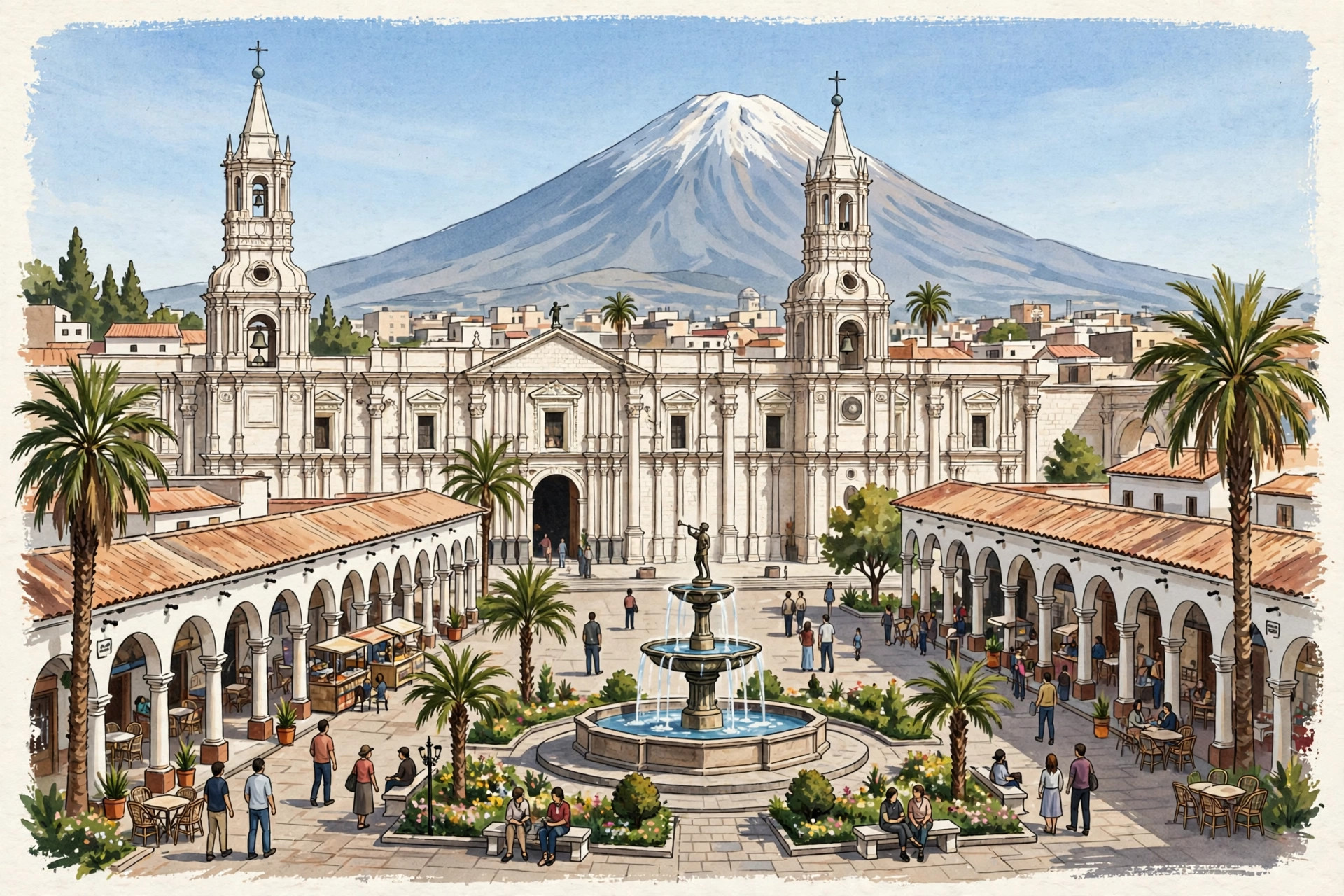
Arequipa is the southern circuit's second anchor, and it earns the title differently from Cusco. Where Cusco is Inca stone and altitude drama, Arequipa is pale, calm, and architectural: a colonial city built from sillar, the white volcanic stone cut from the quarries at its edge, which gives whole streets a luminous quality in the high sun. Behind the rooftops stands El Misti, a near-perfect volcanic cone that turns every plaza photograph into a postcard whether you planned it or not.
At 2,335 meters, Arequipa also does quiet logistical work. It is a genuine step up from the coast that is still well below Cusco, which makes it a humane middle rung on a southbound altitude ladder — and a natural stepping-stone between the coast, Colca, and Puno.
Where in Peru
Schematic list — not for navigationPeru runs in three bands: the Pacific coast in the west, the Andes down the middle, and the Amazon across the east. Almost every first trip moves Lima → Sacred Valley → Cusco, then south to Arequipa and Titicaca, or east to the Amazon. Art for this panel is in production; the places below are placed by region, north to south.
- Lima — Pacific coast · gateway
- Cusco — Andes · 3,400 m
- Sacred Valley (Ollantaytambo) — Andes · 2,792 m
- Machu Picchu — Citadel · 2,430 m
- Arequipa — White City · 2,335 m
- Puno / Lake Titicaca — Altiplano · 3,827 m
- Puerto Maldonado — Amazon gateway
- Iquitos — Amazon River · fly-in
Illustrative schematic. Not for navigation. Open in Google Maps ↗
In the city
The Plaza de Armas is the start: a broad square of sillar arcades with the cathedral taking the whole of one side. From there, the essential visit is the Santa Catalina Monastery, a walled city-within-the-city of cloisters, streets, and painted courtyards that can absorb half a day without effort. Arequipa's food scene — hearty, proud, and distinct from Lima's — fills the rest: this is a city that takes lunch seriously, and the picantería tradition is the way in. Give the city a full day before any canyon talk; travellers who treat Arequipa as a bus stop consistently rate it the surprise of the south once they stay.
Colca Canyon: do it as two days
Colca is the excursion Arequipa exists to launch, and the one most often under-planned. The canyon road runs 3–4 hours each way, and some routings cross a pass at about 4,900 meters — higher than anywhere else on a standard Peru itinerary. The payoff is the Cruz del Cóndor viewpoint, where Andean condors ride the morning thermals out of the canyon within photographing distance, above terraced villages that predate the Inca. Chivay, the canyon's gateway town, adds hot springs that land very well after the pass.
- Minimum shape: 2 days / 1 night. A rushed day trip spends most of its hours on the road, arrives at the viewpoint at the wrong end of the condor morning, and climbs the high pass with no acclimatisation behind it.
- Sequence it after some altitude. Colca belongs mid-trip, not on day two off a sea-level flight.
- Mornings are the product. Staying overnight near the canyon puts you at Cruz del Cóndor when the birds fly; day-trippers from Arequipa are racing the clock to do the same.
Tours we're vetting for Arequipa & Colca
We're lining up launch partners for guided tours in this region — operators we'd book ourselves. When we recommend one, we'll tell you exactly why, and any commission will be disclosed here.
No paid placements yet — when affiliate links go live here, they will be disclosed.
Where Arequipa fits
On the classic southern loop, Arequipa sits between the coast and the lake: Lima down to Arequipa, on to Colca, then across the altiplano to Puno and Lake Titicaca — each step climbing a little, each stop earning the next one's altitude. Run in the other direction, it is the gentler descent from Titicaca toward the coast. Either way, it is a working city with a traveller's old town, not a resort stop: stay central, walk the sillar streets in the late light, and let El Misti do the rest.
Where to stay in Arequipa
Our vetted stay partners for this region are coming with the launch. Until then, every hotel and lodge mention in this guide is editorial — nobody paid to be here.
No paid placements yet — when affiliate links go live here, they will be disclosed.