The core of Peru — and the part that sells out
Everything in Peru bends around this circuit: the former Inca capital at Cusco, the Sacred Valley running down from it, and at the valley's end, reached only by train and shuttle bus, Machu Picchu. It is the finest sequence of places in the country. It is also the most capacity-constrained trip component in South America. The work of this page is simple: explain the rules as they currently stand, so the circuit you dream about is the circuit you actually walk.
Start with the shape. Cusco (3,400 m) holds Qorikancha and Inca stonework of a precision that still stops engineers mid-sentence, wrapped in a colonial city built on Inca foundations. The Sacred Valley drops away below it: Pisac with its terraces and market, Urubamba as the practical sleeping town, Ollantaytambo as the fortress town where the trains begin, and the Maras salt pans and Moray terraces on the valley's shoulder. Machu Picchu (2,430 m) sits beyond Ollantaytambo, lower than all of it — which is the first clue to sequencing the whole circuit correctly.
Where in Peru
Schematic list — not for navigationPeru runs in three bands: the Pacific coast in the west, the Andes down the middle, and the Amazon across the east. Almost every first trip moves Lima → Sacred Valley → Cusco, then south to Arequipa and Titicaca, or east to the Amazon. Art for this panel is in production; the places below are placed by region, north to south.
- Lima — Pacific coast · gateway
- Cusco — Andes · 3,400 m
- Sacred Valley (Ollantaytambo) — Andes · 2,792 m
- Machu Picchu — Citadel · 2,430 m
- Arequipa — White City · 2,335 m
- Puno / Lake Titicaca — Altiplano · 3,827 m
- Puerto Maldonado — Amazon gateway
- Iquitos — Amazon River · fly-in
Illustrative schematic. Not for navigation. Open in Google Maps ↗
Machu Picchu: the rules now in force
The system below has been in force since June 2024 and continues through 2026. Verified Oct 2026
- Daily cap: 4,500 visitors in regular season, rising to 5,600 on designated high-season dates. For 2026, high season runs 1 June to 2 November, plus 30–31 December.
- Three circuits, ten routes, all one-way and timed. No switching circuits, no re-entry. Most routes allow roughly 2.5 hours; the mountain routes run longer, up to 6–7 hours for Huayna Picchu, Machu Picchu Mountain, and the Great Cavern.
- Circuit 1 — Panorámico: 1-A Machu Picchu Mountain, 1-B Upper Terrace, 1-C Inti Punku / Sun Gate (high season only), 1-D Inca Bridge (high season only). The viewpoint circuit.
- Circuit 2 — Clásico: 2-A Designed Route and 2-B Lower Terrace. The fullest classic visit through the citadel itself — and the first to sell out.
- Circuit 3 — Realeza (Royalty): 3-A Huayna Picchu, 3-B Designed (the royal lower sector), 3-C Great Cavern (high season only), 3-D Huchuy Picchu (high season only).
- One sales channel only: the Ministry of Culture's official Tu Boleto platform. Tickets are personal, named, and tied to your passport number. They are non-transferable, names cannot be changed, and you must bring the same passport you booked with.
- Entry tolerance is short: reported at 30 minutes in low season and 45 minutes in high season. Arrive after your window and you can be refused.
- The in-person reserve is a salvage option, not a plan: 1,000 tickets a day are held for in-person sale at the Cultural Centre in Machu Picchu Pueblo (Aguas Calientes) and never appear online. In peak 2026 that meant waits of 48–72 hours.
Booking window, honestly: secure tickets 60+ days ahead for peak dates, and 2–3 months ahead for June–August, Circuit 2, or Huayna Picchu. Off-peak, 2–4 weeks can work. A Tu Boleto reservation hold lasts only about 15 minutes before the slot is released for payment, so have passport details and payment ready before you start.
The Inca Trail: a separate permit world
The classic Inca Trail is not a walk-up hike. It admits 500 people per day in total, of whom only about 200 are hikers — the rest are the guides, porters, and cooks who make the trail function. Permits are sold only through licensed operators, are tied to your passport, and are non-transferable and non-refundable. The trail closes for all of February for maintenance. Peak April–October permits go at the annual release (2026 permits were released on 17 November 2025), so a high-season trail date is a book-the-year-before decision. Under the current circuit rules, trail arrivals enter Machu Picchu on Circuit 3-B.
The train chain — there is no road
There is no road to Aguas Calientes. The standard chain runs: Cusco → road or bimodal bus → Ollantaytambo → train → Aguas Calientes (Machu Picchu Pueblo) → Consettur shuttle bus, about 25–30 minutes, up to the gate (or a steep hike of roughly 2.5 hours). Direct trains also run from Poroy, near Cusco, at about 3 hours 20 minutes. Two operators, PeruRail and Inca Rail, run everything from sightseeing cars to luxury services; bimodal tickets bundle the Cusco–Ollantaytambo bus and the train into one product of about 4 hours door to door.
- Book the citadel ticket first, then fit the train to its entry hour. A train that arrives after your tolerance window is worthless, however scenic.
- Peak trains sell out with the tickets: 30+ days ahead at minimum, 2–3 months for June–August.
- Sleep in Aguas Calientes or Ollantaytambo where you can. A same-day Lima→Cusco→Machu Picchu return is fragile against delays and altitude, and it wastes the valley.
- Train luggage limits are restrictive. Main bags stay in storage in Cusco or the valley; travel to the citadel with a small pack.
Tours we're vetting for Cusco & Machu Picchu
We're lining up launch partners for guided tours in this region — operators we'd book ourselves. When we recommend one, we'll tell you exactly why, and any commission will be disclosed here.
No paid placements yet — when affiliate links go live here, they will be disclosed.
Altitude: sleep low first, every time
The flight from Lima lands you at 3,400 meters about an hour and twenty minutes after leaving sea level. The standard mitigation is consistent across every serious operator: transfer straight down to the Sacred Valley on arrival, sleep lower for one to two nights, visit Machu Picchu, and only then sleep in Cusco. Take the first 24–48 hours without strenuous trekking, alcohol, or heavy exertion. Save the high add-ons — Rainbow Mountain and the Humantay side trips climb far above Cusco — for later in the stay. Coca tea is traditional and everywhere; do not carry coca leaves or products home, where they are a controlled substance, and if symptoms worsen, descend and seek medical care rather than pushing through. Prescription altitude medication is a conversation with your own doctor before departure, not a decision to make at the hotel desk.
Cusco city, enjoyed properly
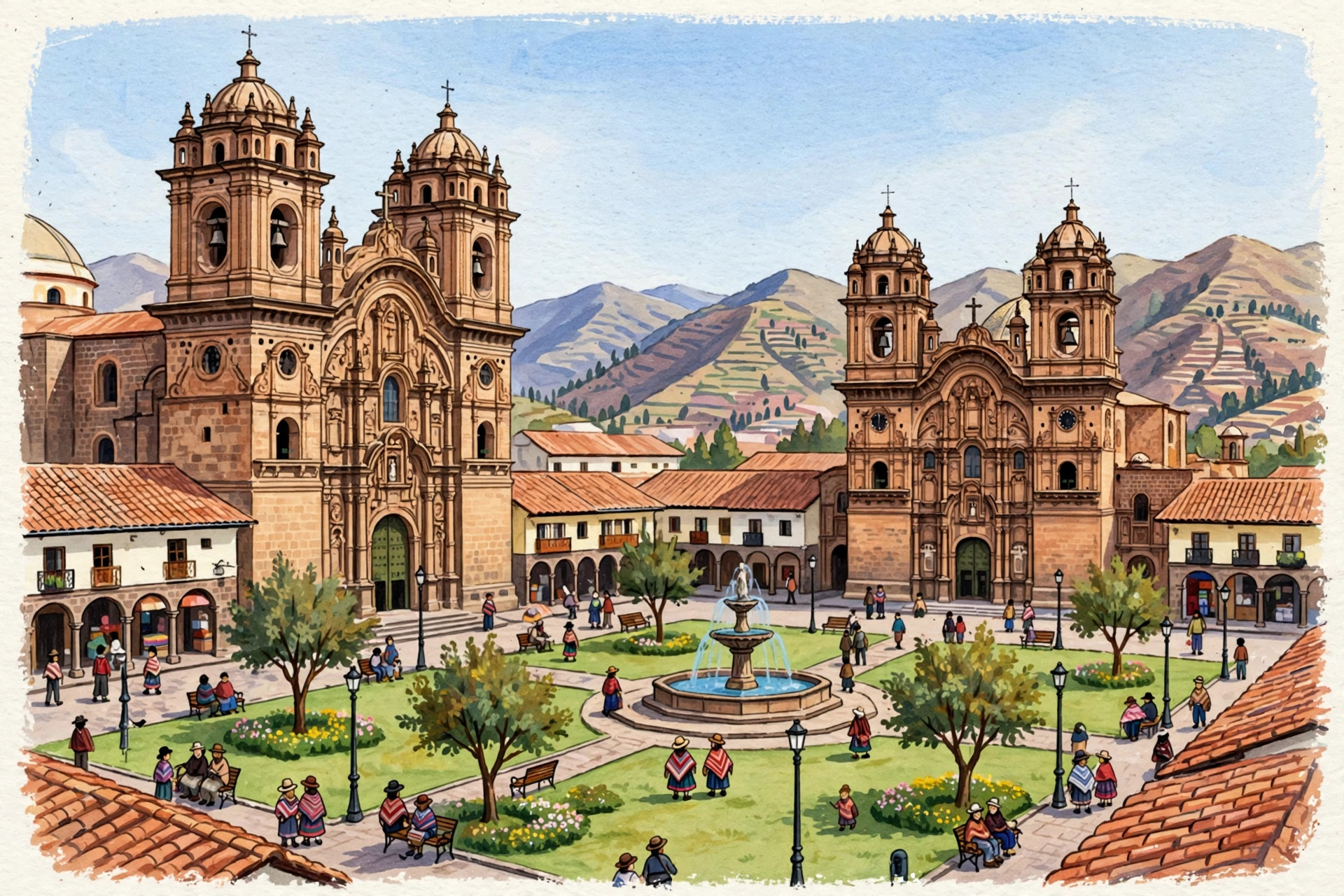
Once acclimatised, Cusco rewards slow days. The Plaza de Armas pairs the cathedral with La Compañía church across a square ringed by arcades — the postcard, and genuinely beautiful at altitude light. Qorikancha, the Inca temple of the sun later wrapped in a colonial convent, is the single best place to understand what the city was. Between sights, the craft neighbourhoods and markets fill the hours that the altitude says you should not spend climbing. Give Cusco its own days at the end of the valley sequence, and it stops feeling like a transit point with good stonework.
Where to stay in Cusco & the Sacred Valley
Our vetted stay partners for this region are coming with the launch. Until then, every hotel and lodge mention in this guide is editorial — nobody paid to be here.
No paid placements yet — when affiliate links go live here, they will be disclosed.